Friday, December 20, 2013

Delightful December

This was taken in Peteluma.  I couldn't believe the bird just sat there and let me snap as many pictures as I wanted.  I believe it is a red-tail hawk.  It was such a delightful day out, just like my next two weeks will be.  If it wasn't for yoga, friends, and these outings, I would quit my job which means retire early and volunteer.  Then I could choose which students to work with.  I love my job, but I don't like some students ruining the experience for other students continuously day after day.  I want to teach, not babysit.  Enough said...

Habitat and Diet

  • Red-tailed hawks are birds of prey. They hunt rabbits, squirrels, lizards, mice or other rodents (or any small animal). Their sharp vision allows them to spot their targets from the height of trees or telephone poles. Red-tailed hawks prefer to live in open spaces, such as fields, deserts and mountains, where it can be more difficult for prey to hide. The space also allows the aerial hunter to dive down and catch its prey. Hawks, unlike falcons, dive slowly, feet first, with their talons outstretched and ready to grab their meal.

Mating

  • These birds of prey mate for life. Their typical mating ritual involves dancing together through the air; a dance that ends with a death-defying stunt. The birds lock their talons together and plummet toward the ground in an uncontrolled fall before separating again. Once mated, red-tailed hawks will often hunt as a team. They also parent as a team, taking turns warming eggs and feeding chicks. Red-tail hawks often choose a territory of their own, living in the same nest and hunting in the same fields throughout their lives.

Some Fun Facts

  • Did you know that red-tailed hawks are one of the few birds of prey that actually "scream?" According to the Cornell Lab of Ornithology, whenever a bird of prey (of any species) is shown hunting or diving in films, the sound effect that is used is almost always a red-tailed hawk cry. Despite fearsome cry and large size, the biggest of red-tailed hawks rarely weighs more than three pounds. Red-tailed hawks also have an impressive life span, averaging 21 years in the wild. The oldest known red-tailed hawk lived almost 29 years.

Sunday, October 6, 2013

Humming Around

While hanging out at my parents' house this weekend and waiting for my dad to connect with the pharmacist, I spotted a hummingbird also hanging out.  I think he was protecting his territory.  When I first glanced out the door, I thought it was another leaf on the peach tree. I think this is a Allan but not sure.


This little fellow reminds me of my students this year.  Sometimes calm and attentive, other times flighty, unfocused, here, there, and everywhere.

Basic Facts About Hummingbirds

Hummingbirds are small, colorful birds with iridescent feathers. Their name comes from the fact that they flap their wings so fast (about 80 times per second) that they make a humming noise. Hummingbirds can fly right, left, up, down, backwards, and even upside down. They are also able to hover by flapping their wings in a figure-8 pattern. They have a specialized long and tapered bill that is used to obtain nectar from the center of long, tubular flowers. The hummingbird’s feet are used for perching only, and are not used for hopping or walking.
 

Diet

Hummingbirds primarily eat flower nectar, tree sap, insects and pollen.
The hummingbird’s fast breathing rate, fast heartbeat and high body temperature require that they eat often. They also require an enormous amount of food each day. Hummingbirds have a long tongue which they use to lick their food at a rate of up to 13 licks per second.

Population

It is difficult to estimate population numbers since there are many different species spanning a large geographic area.

Range

Hummingbirds are found only in the Western Hemisphere, from southeastern Alaska to southern Chile, although most live in the tropics. There are 320 species of hummingbirds, 12 of which summer in North America and winter in tropical areas.

Behavior

Like other birds, hummingbirds communicate via visual displays. Hummingbirds are very territorial and have been observed chasing each other and even larger birds such as hawks away from their territories.

Tuesday, April 30, 2013

In the Merry Month of May


We'll be celebrating Colonial Days next week at school and one of the activities will be using a quill to write a fancy message.  The quills will be made from turkey feathers compliments of Loma Vista turkeys.  I think this fellow contributed quite a few feathers.  So a little information about turkeys is now in order...

How the Turkey Got Its Name

There are a number of explanations for the origin of the name of Thanksgiving's favorite dinner guest. Some believe Christopher Columbus thought that the land he discovered was connected to India, and believed the bird he discovered (the turkey) was a type of peacock. He therefore called it 'tuka,' which is 'peacock' in Tamil, an Indian language.
Though the turkey is actually a type of pheasant, one can't blame the explorer for trying.
The Native American name for turkey is 'firkee'; some say this is how turkeys got their name. Simple facts, however, sometimes produce the best answers—when a turkey is scared, it makes a "turk, turk, turk" noise.

Turkey Facts

  • At one time, the turkey and the bald eagle were each considered as the national symbol of America. Benjamin Franklin was one of those who argued passionately on behalf of the turkey. Franklin felt the turkey, although "vain and silly", was a better choice than the bald eagle, whom he felt was "a coward".
  • According to the U.S. Department of Agriculture, more than 45 million turkeys are cooked and eaten in the U.S. at Thanksgiving—that's one sixth of all turkeys sold in the U.S. each year. American per capita consumption of turkeys has soared from 8.3 pounds in 1975 to 18.5 pounds in 1997. Ten years later, the number dropped in 2007 to 13.8 pounds.
  • In 2010, more than 242 million turkeys were raised with an average liveweight per bird of 28 pounds with nearly 6 billion pounds of turkey processed. By contrast, in 1970, only 105 million birds were raised with an average liveweight of 17 pounds and 1.5 billion pounds processed. The turkeys produced in 2009 together weighed 7.1 billion pounds and were valued at $3.6 billion.
  • In 2002, retail sales of turkey was approximately $3.6 billion. Forecasts for 2010 expect sales to reach $4.18 billion.
  • Age is a determining factor in taste. Old, large males are preferable to young toms (males) as tom meat is stringy. The opposite is true for females: old hens are tougher birds.
  • A turkey under sixteen weeks of age is called a fryer, while a young roaster is five to seven months old.
  • Turkeys are the only breed of poultry native to the Western Hemisphere.
  • Turkeys have great hearing, but no external ears. They can also see in color, and have excellent visual acuity and a wide field of vision (about 270 degrees), which makes sneaking up on them difficult. However, turkeys have a poor sense of smell (what's cooking?), but an excellent sense of taste.
  • Domesticated turkeys cannot fly. Wild turkeys, however, can fly for short distances at speeds up to 55 miles per hour. They can also reach speeds of 25 miles per hour on the ground.
  • Turkeys sometimes spend the night in trees.
  • Turkeys can have heart attacks: turkeys in fields near the Air Force test areas over which the sound barrier was broken were known to drop dead from the shock of passing jets
  • The ballroom dance known as the Turkey Trot was named for the short, jerky steps a turkey makes.

Sunday, February 10, 2013

Wow - It's been a year!

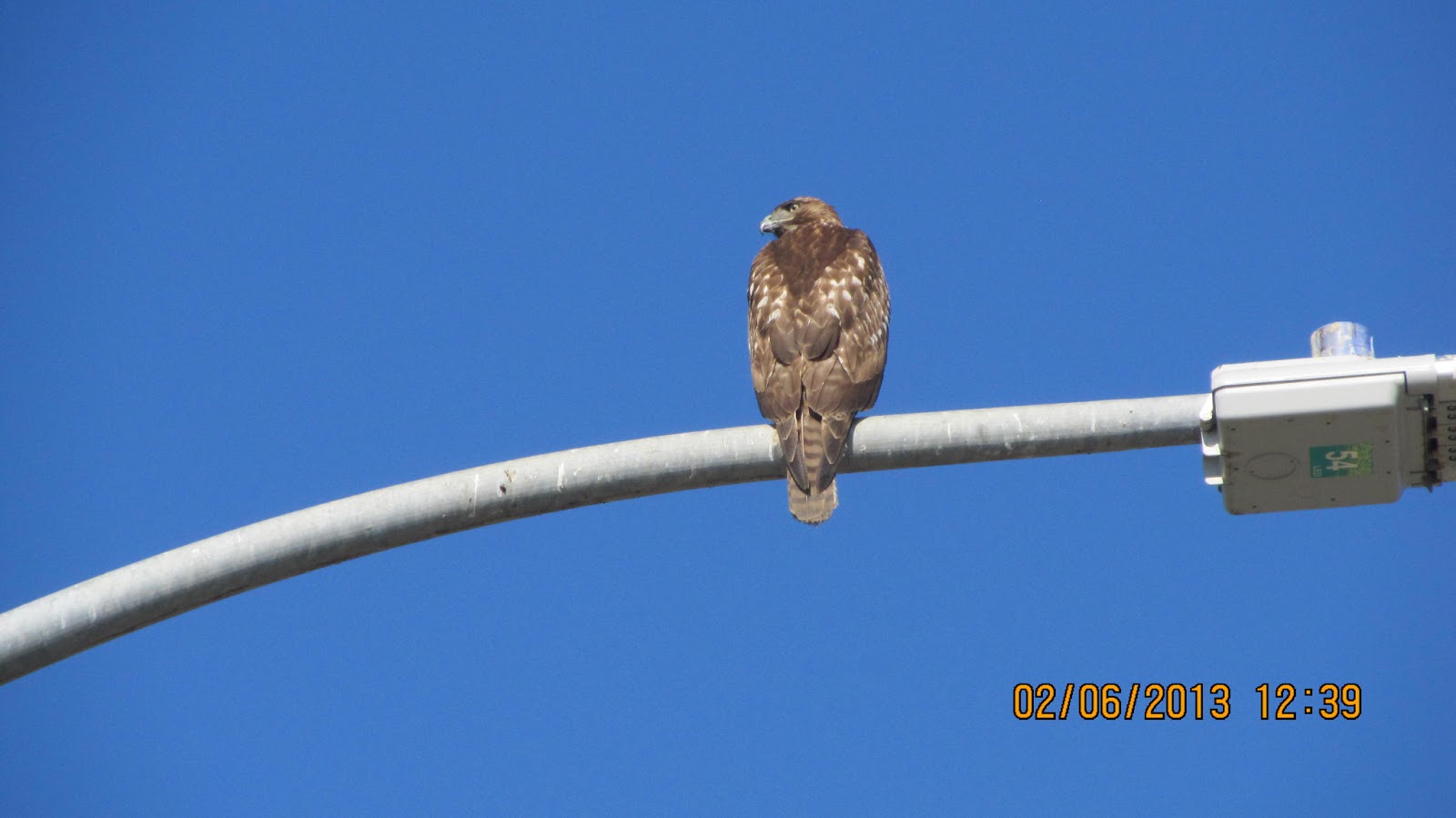
I can' t believe I finally got a shot of a hawk.  I see them all the time, but never get the opportunity to pull over and capture the image.  This is a red-shouldered hawk, but I didn't see white stripes on the tail.  I welcome any corrections to set me straight.  It reminds me of me looking out over my students.  Though just like the hawk sometimes doesn't get its prey, students get out of my protective eye, which is what happened this week - actually two students and it happened twice - yikes, not good!  Anyway, I had a wonderful day out in American Canyon at the Flyway Festival.  Here is some information about red-shouldered hawks:


Whether wheeling over a swamp forest or whistling plaintively from a riverine park, a Red-shouldered Hawk is typically a sign of tall woods and water. It’s one of our most distinctively marked common hawks, with barred reddish-peachy underparts and a strongly banded tail. In flight, translucent crescents near the wingtips help to identify the species at a distance. These forest hawks hunt prey ranging from mice to frogs and snakes.

Keys to identification Help

Hawks
Hawks
Typical Voice
  • Size & Shape

    Red-shouldered Hawks are medium-sized, with broad, rounded wings and medium-length tails that they fan out when soaring. In flight, they often glide or soar with their wingtips pushed slightly forward, imparting a distinctive, “reaching” posture.
  • Color Pattern

    Adults are colorful hawks with dark-and-white checkered wings and warm reddish barring on the breast. The tail is black with narrow white bands. Immatures are brown above and white below streaked with brown. All ages show narrow, pale crescents near the wingtips in flight.
  • Behavior

    Red-shouldered Hawks soar over forests or perch on tree branches or utility wires. Its rising, whistled kee-rah is a distinctive sound of the forest. They hunt small mammals, amphibians, and reptiles either from perches or while flying.
  • Habitat

    Look for Red-shouldered Hawks in deciduous woodlands, often near rivers and swamps. They build stick nests in a main crotch of a large tree. During migration, Red-shouldered Hawks often move high overhead along ridges or along the coast.

Friday, December 28, 2012

Ending the Year

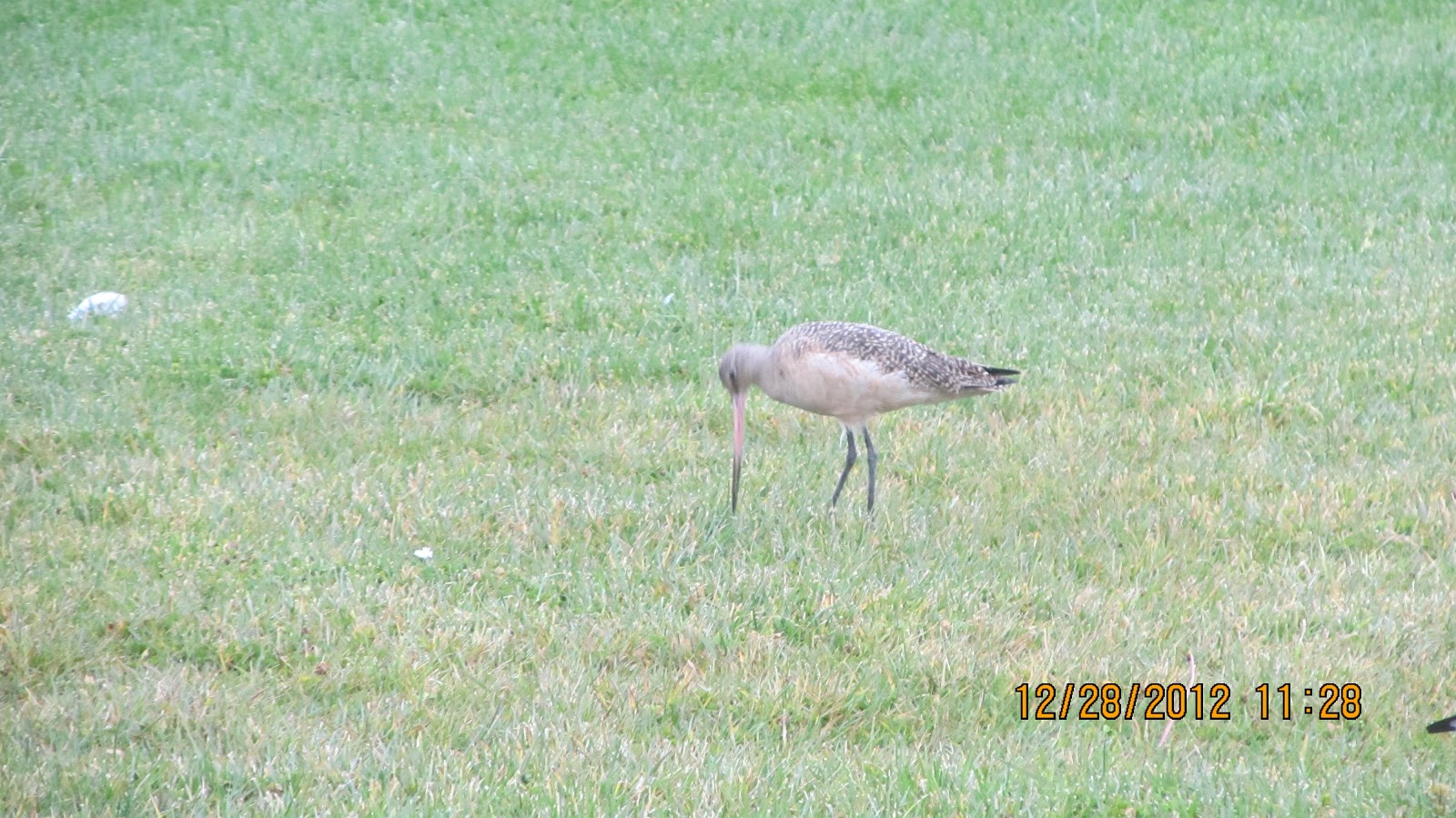
Well, it's been ages, so I might as well end the year with a bird blog.  I was out walking on the Vallejo waterfront this morning with a friend and spotted this unusual bird in the midst of all the seagulls.  This beak could come in handy for a lot of things...ear cleaning, stabbing stale stollen, knitting...well, use your imagination. 

Marbled Godwit

a large shorebird. On average, it is the largest of the 4 species of godwit. The total length is 40–50 cm (16–20 in), including a large bill of 8–13 cm (3.1–5.1 in), and wingspan is 70–88 cm (28–35 in).[2] Body mass can vary from 240 to 510 g (8.5 to 18 oz).[3]
Adults have long blue-grey hairy legs and a very long pink bill with a slight upward curve and dark at the tip. The long neck, breast and belly are pale brown with dark bars on the breast and flanks. The back is mottled and dark. They show cinnamon wing linings in flight.
Their breeding habitat is the northern prairies of western Canada-(Canadian Prairies), and the north central Great Plains, United States near marshes or ponds. They nest on the ground, usually in short grass.
In autumn, they migrate in flocks to the coasts of California, the Gulf of Mexico, Mexico and South America.
These birds forage by probing on mudflats, in marshes, or at the beach (see picture below). In short grass, they may pick up insects by sight. They mainly eat insects and crustaceans, but also eat parts of aquatic plants.
Their numbers were reduced by hunting at the end of the 19th century. Although they had recovered somewhat since that time, their population has declined in recent times as suitable habitat is used for farming.

Thursday, August 2, 2012

Staycation

Our travel buddy came out from Connecticut and visited for a few days and we did the "show off where you live" thingy.  We had great weather and hit various areas - Pt Reyes, Folsom and Sacramento, and Sonoma.  And, the Giants were soooo kind to let the Mets win since that is C's favorite team.  We had a good time!  So, here's a little info on woodpeckers.  I think this is an acorn woodpecker which is the type from which Woody was created.  We saw it at Sutter's Fort.  I got this information from Wikipedia.

Description

The adult Acorn Woodpecker has a brownish-black head, back, wings and tail, white forehead, throat, belly and rump. The eyes are white. There is a small part on the small of their backs were there are some green feathers. The adult male has a red cap starting at the forehead, whereas females have a black area between the forehead and the cap. The white neck, throat, and forehead patches are distinctive identifiers. When flying, they take a few flaps of their wings and drop a foot or so. White circles on the their wings are visible when in flight. Acorn Woodpeckers have a call that is almost like they are laughing.

Breeding communities

The breeding habitat is forested areas with oaks in the hills of coastal areas and foothills of California and the southwestern United States south to Colombia. This species may occur at low elevations in the north of its range, but rarely below 1000 m in Central America, and it breeds up to the timberline. The breeding pair excavate a nest in a large cavity in a dead tree or a dead part of a tree. A group of adults may participate in nesting activities: Field studies have shown that breeding groups range from monogamous pairs to breeding collectives of seven males and three females, plus up to 10 nonbreeding helpers. Young from a single brood have been found with multiple paternity.[1]
Male Acorn Woodpecker with "Granary Tree" full of acorns
Acorn hoarded by Acorn Woodpecker

Food and homes

Acorn woodpeckers, as their name implies, depend heavily on acorns for food. In some parts of their range (e.g., California), the woodpeckers create granaries or "acorn trees" by drilling holes in dead trees, dead branches, telephone poles, and wooden buildings. The woodpeckers then collect acorns and find a hole that is just the right size for the acorn. As acorns dry out, they are moved to smaller holes and granary maintenance requires a significant amount of the bird's time. They also feed on insects, sap, and fruit.

Defense and storing

The acorns are visible, and the group defends the tree against potential cache robbers like Steller's Jays and Western Scrub Jays. Acorns are such an important resource to the California populations that Acorn Woodpeckers may nest in the fall to take advantage of the fall acorn crop, a rare behavior in birds.[2] Acorn Woodpeckers can also be seen sallying from tree limbs to catch insects, eating fruit and seeds, and drilling holes to drink sap. The Acorn Woodpecker will use any human-made structures to store acorns, drilling holes into fence posts, utility poles, buildings, and even automobile radiators. Occasionally the woodpecker will put acorns into places where it cannot get them out. Woodpeckers put 220 kg (490 lb) of acorns into a wooden water tank in Arizona. In parts of its range the Acorn Woodpecker does not construct a "granary tree", but instead stores acorns in natural holes and cracks in bark. If the stores are eaten, the woodpecker will move to another area, even going from Arizona to Mexico to spend the winter.

Breeding behavior

In California, Acorn Woodpeckers breed from May–July. An Acorn Woodpecker group may consist of 1–7 male breeders that compete to mate with 1–3 females. The nest is excavated in a large tree, which may also be a granary tree. Tree cavities are created in both dead and living trees and snags and nest holes are reused for many years. Females typically lay 5 eggs that are incubated for 11–14 days. Male and females incubate and tend to their young. Non-breeding helpers (young from previous years) often help with incubation and other parental duties. The young leave the nest and take their first flight at approximately 30–32 days after hatching and return to the nest to be fed for several weeks.

Breeding female

In groups with more than one breeding female, the females put their eggs into a single nest cavity. A female usually destroys any eggs in the nest before she starts to lay, and more than one third of all eggs laid in joint nests are destroyed. Once all the females start to lay, they stop removing eggs.
This bird is a permanent resident throughout its range. They may relocate to another area if acorns are not readily available. It is sedentary and very sociable.

Threats and degradation

Female bathing in California, USA
Acorn Woodpeckers like many other species are threatened by habitat loss and degradation. Competition for nest cavities by non-native species is an ongoing threat in urbanized areas. Conservation of this species is dependent on the maintenance of functional ecosystems that provide the full range of resources upon which the species depends. These include mature forests with oaks capable of producing large mast crops and places for the woodpeckers to nest, roost, and store mast. Residents are encouraged to preserve mature oak and pine-oak stands of trees and to provide dead limbs and snags for nesting, roosting, and granary sites to help preserve the Acorn Woodpecker's population.

Popular culture

Walter Lantz is believed to have patterned the call of his cartoon character Woody Woodpecker on that of the acorn woodpecker, while patterning his appearance on that of the Pileated Woodpecker which has a prominent crest.[3]

Thursday, July 26, 2012

California Quail

We went to visit K's aunt today and there was a quail family out in the patio area.  The babies were like little wisps running and tumbling so quickly I could not get a picture of them.  It was a beautiful day and felt good to willow the hours away.  The last few days have been spent cleaning and organizing in the classroom and the school dreams have returned.
The California Quail is a handsome, round soccer ball of a bird with a rich gray breast, intricately scaled underparts, and a curious, forward-drooping head plume. Its stiffly accented Chi-ca-go call is a common sound of the chaparral and other brushy areas of California and the Northwest. Often seen scratching at the ground in large groups or dashing forward on blurred legs, California Quail are common but unobtrusive. They flush to cover if scared, so approach them gently. 

Keys to identification Help

Gamebirds
Gamebirds
Typical Voice
  • Size & Shape

    California Quail are plump, short-necked game birds with a small head and bill. They fly on short, very broad wings. The tail is fairly long and square. Both sexes have a comma-shaped topknot of feathers projecting forward from the forehead, longer in males than females.
  • Color Pattern

    Adult males are rich gray and brown, with a black face outlined with bold white stripes. Females are a plainer brown and lack the facial markings. Both sexes have a pattern of white, creamy, and chestnut scales on the belly. Young birds look like females but have a shorter topknot.
  • Behavior

    California Quail spend most of their time on the ground, walking and scratching in search of food. In morning and evening they forage beneath shrubs or on open ground near cover. They usually travel in groups called coveys. Their flight is explosive but lasts just long enough to reach cover.
  • Habitat

    You’ll find California Quail in chaparral, sagebrush, oak woodlands, and foothill forests of California and the Northwest. They’re quite tolerant of people and can be common in city parks, suburban gardens, and agricultural areas.